Moving Can be a Taxing Decision
By James O. Armstrong
So, what motivates employees to move during retirement? While there may be other factors, this list covers a number of the considerations many of our fellow baby boomers and others consider important in making such a decision.
First, we may decide to move because a specific job offer emerges from either the private or public sector. This offer to someone in greater demand could also include a future independent contractor status or registration with a speaker's bureau or talent agency, for example. Or, it may include starting your own business or even buying a franchise with an established business plan and strategy to pursue.
Second, we may decide to move because of family considerations, which range from aging parents to relocating so that we can be closer to our children and grandchildren. In fact, a number of my daughter's closest young adult friends in Greater St. Louis have talked about their parents taking precisely this step recently. By the way, this observation includes the movement of grandparents to the St. Louis area, who have never before lived in that region.
Third, men and women also choose to move to a more exciting part of the US or they may choose to live abroad, which an increasing number of Americans are now deciding to do. For example, a fellow baby boomer web entrepreneur, Ann Fry, decided to move from Austin, TX to New York City over the past year and she has never looked back on her decision. The 62 year old Ann runs a successful web site plus works as a motivational speaker and career coach. So, part of her relocation formula has included an upsurge in her speaking engagements and coaching assignments, especially since she moved to New York, despite the warnings of doom and lack of success from her Austin, Texas-based friends.
Fourth, other men and women choose to move to a different part of the US especially for tax reasons. But, of course, the question, which quickly emerges in this complex set of variables is "which taxes?" Many of us no doubt already know Texas or Florida (part-time) citizens, who have emigrated to these states because neither levies a state income tax. Of course, the winning formula is that "they" actually live in their adopted states for one-half of the year plus one day.
But, did you know that there are actually a total of seven states with no income tax as follows: (1) Alaska, (2) Florida, of course, (3) Nevada, (4) South Dakota, (5) Texas, (6) Washington and (7) Wyoming. In addition, New Hampshire and Tennessee only tax interest and dividends.
Likewise, it should be clearly said that a total of 26 states plus the District of Columbia do not tax Social Security benefits. IMPORTANT: Our web site, www.NowWhatJobs.net, is against any states taxing Social Security income. From our standpoint, because of the current and coming labor shortages and especially because of the current skills shortages, our society cannot afford to do anything, which has the net effect of discouraging men and women from continuing to work in America.
Finally, other men and women will factor some or all of these issues into consideration, when deciding where and when to move in our society. In the final analysis, even local sales taxes and property taxes can and should enter into this equation. For example, the City of Chicago recently passed an incredibly high local sales tax, which put this great city at or near the top of local sales taxes in the whole US among major cities. Of course, this consideration only becomes important when someone wants to buy something, whatever that may be.
To tax or not to tax -- that will indeed be the question for state and local governments in the future in the US and elsewhere, as a wave of baby boomers begin to consider all of their relocation factors and options. "Yes," state and local governments would like the bank deposits, which provide the necessary capital needed for consumer loans and local businesses to expand and create even more jobs in that area. "Yes," state and local governments would also like men and women, who will not be adding to the local student population in our nation's public schools, but who will never the less be adding to the local property tax base. "Yes," state and local governments would also like to have men and women, who are creditworthy and who have a greater equity position in their homes move into the community.
But, what if anything are these state and local governments willing to do in order to court "our" favor, you might logically ask? This writer submits to you that the answer to this question will cause state and local governments around the US to make a whole series of different decisions, both now and in the near future, in order to demonstrate "their friendliness" to my fellow baby boomers, who are 78 million strong just in the US.
JAMES O. ARMSTRONG BIOGRAPHY
James O. Armstrong, President of NowWhatJobs.net, Inc., http://www.nowwhatjobs.net, also serves as the Editor of NowWhatJobs.net. NowWhatJobs.net is the resource for job and career transitions for workers 40 years old and over, Baby Boomers and Active Seniors. Read NowWhatJobs.net for skills training, relocation options, job opportunities and much more. In addition, James is the author of "Now What? Discovering Your New Life and Career After 50" and the President of James Armstrong & Associates, Inc., a media representation firm based in Suburban Chicago.
Friday, September 19, 2008


Tuesday, August 12, 2008
Retirement Planning: 4 Tips to Help you Retire Worry Free
Retirement Planning: 4 Tips to Help you Retire Worry Free
By: Jim Gianoglio.
Retirement planning can be stressful. If you think about it, you are planning for a time in your life when you won’t be working, yet you’ll still be consuming. There are a lot of things to consider in addition to day-to-day expenses: extended health care, emergencies, planning a legacy… the list is long. How can you make sure you are saving enough for retirement?
Here are four ways you can plan for your retirement worry free:
1. Know yourself and prepare for change. Try out new roles in social, community, charitable, cultural, or recreational organizations and try new activities before you retire. Why? Because it’s important to know what you’ll be interested in so you have an idea of what kind of expenses you’ll face. In retirement you are going to have needs to fulfill and require new ways to keep stimulated. Now’s the time to figure out what your “drivers” are and what’s really important to you, if you haven’t already.
2. Increase savings. Having to increase your savings shouldn’t surprise you, especially if you hope to retire early. Put money aside whenever possible. One great way to save is to set up an automatic savings plan, or to boost your contributions if you already have one. Try and invest your income tax refund instead of spending it.
3. Plan for a longer retirement. Thanks to medical advances and healthier lifestyles, people are living longer. Sounds great, right? The only downside is you now have to plan for a longer retirement. Previously, you could expect to spend 15-20 years in retirement. Today, you should plan on creating a savings that will last for potentially 30 years.
4. Upsizing or downsizing. It is easy to say you don’t need to save as much because you won’t be as active and can downsize your lifestyle. In many cases, retirement is exactly the opposite. Extensive travel, fine dining, and joining an exclusive golf club are just a few of the upsizing many retirees embrace. While either choice is possible, they both require forward planning. The key to being successful with your planning is to be honest. Realistically decide if you want to live it up now that you have the time, and then tailor your financial plan to it.
Remember, retirement is your chance to do the things you’ve always wanted to do, but didn’t have time for. Using an online retirement planning calculator will get you started, but don’t stop there. A professional financial advisor can help you make your retirement an exciting new life by being financially prepared.
Retirement Planning Calculator
Tuesday, July 22, 2008
Condo Trends.
According to the article by M. Anthony Carr on Realty Times, the author said that Boomers are driving the trend of Less Is More.
He said that traditionally downsizing is not unusal for silver-haired generation. He added that in the 21st century, downsizing is speeding up since baby boomers are becoming enpty-nesters which tremendously changed their lifestyle.
"They are seriously considering the convenience of 'lock-and-go' versus a lifestyle tied to big homes," says Murray Lawson, to the Calgary Herald. The managing broker for Royal LePage Coast Capital Chatterton has been watching boomers seek out low-cost alternatives to the high rents and maintenance of the single-family dwelling lifestyle.
Carr stated that the downsizing of home mean that all the furnishings are going to have to be downsize as well. This trend got everyone involved inclding the Realtors as well as the furniture retail outlets. Condo buyers no longer can fit in king-sized bed for wall beds and smaller living room suits. No longer can they continued to have big comfy couch that looks perfect in the 240-foot living room in the traditional colonial. They are going to need a much small one in a 144-foot den in the luxury condo.
Moving consultant Jane Dewing in Calgary says it can actually be stressful, saying residents realize they "have to make conscious decisions to relinquish items they might have had for many years."
The article suggests that boomers downsize every 5 years and try to minimize the major downsizing at one time.
Read the whole article:
Tuesday, May 6, 2008
Theme Park For Boomers?
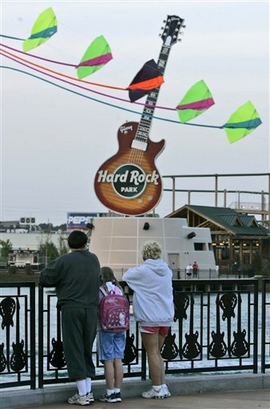
Visitors look out over the 55 acre Hard Rock park built around a lake dominated by 70 foot replica of a Les Paul guitar Saturday, April 26, 2008, in Myrtle Beach, S.C.
(AP Photo/Mary Ann Chastain)
Now that we are retiring, we can travel far and away.... I still wish that it was built in California though.
Led Zeppelin, Moody Blues rides at new Hard Rock Park in SC
By BRUCE SMITH, Associated Press Writer Tue May 6, 12:47 PM ET
MYRTLE BEACH, S.C. - The Led Zeppelin classic "Whole Lotta Love" throbs from the 1,200-watt sound system as the slick silver and white roller coaster nears the top of its serpentine track.
Lead singer Robert Plant shrieks, "Woman. You need. Loooooooove..." And as he does, riders scream as the car falls from a height of 155 feet, reaching speeds of 65 mph.
Welcome to Hard Rock Park, America's newest theme park and the first one built in the nation in a decade. Here the theme is not movies or fairy tales or water shows. It's that American invention, rock 'n' roll.
The $400 million park in the heart of South Carolina's $16 billion tourism industry had a soft opening in April that it called a "sound check." The grand opening is slated for June 2-3, with concerts by the Eagles and The Moody Blues.
As has Led Zeppelin, both groups have lent their names to key attractions at the 55-acre park built around a lake dominated by 70-foot replica of a Les Paul guitar.
The Eagles' "Life in the Fast Lane" roller coaster spins through what appears to be an abandoned saw mill as the hit song plays. "Nights in White Satin, The Trip" winds through the dark amid psychedelic lights and images set to the 1960s Moody Blue's hit.
Nearby looms a reproduction of the Statue of Liberty with sun glasses, and holding not a torch, but a Zippo cigarette lighter. Engraved on the pedestal is a quote from Neil Young: "Keep On Rockin' in the Free World." The park also hosts nightly fireworks shows choreographed to "Bohemian Rhapsody," and one of its eateries is called Alice's Restaurant, after the Arlo Guthrie song.
The park is the first foray by Hard Rock, best known for its cafes, into the amusement park business.
"We realized everybody had done movie parks," said Steven Goodwin, the park's chief executive officer. "Why do something everyone else has done in Orlando and Paramount parks around the country? We just thought rock 'n' roll was a natural."
Building a theme park around music guarantees an audience from children to seniors.
"Music is one of those things that connects emotionally with us," he said. "You hear a song and you immediately have a memory or a related emotional experience. That's what we're trying to create here."
"What younger kids have been exposed to is very eclectic because of the Internet and the iPod," said Jon Binkowski, the park's chief creative officer.
"Younger kids have been exposed to be the Beatles and the Rolling Stones and things like that."
The park is divided into areas such as British Invasion, which features the bus the Beatles used in the film "Magical Mystery Tour."
Among the other areas are Cool Country, Born in the USA and even Rock and Roll Heaven, where the names of 350 musicians playing in that big concert hall in the sky are engraved bricks and stone as a memorial.
Visitors can see swimmers and divers perform in a show called "Malibu Beach Party," play arcade games such as Whack-A-Boys-Band — similar to Whac-a-Mole — and catch live musical performances throughout the park.
All the while, rock music from different eras plays seamlessly through the park's elaborate sound system.
"You can layer rock 'n' roll over a theme park. It's just a natural," Binkowski said. "Music makes a connection that a movie doesn't. Movies continually have to tap back into music to get their flavor and their soul."
Hard Rock is the first new park built in the nation in a decade, according to the International Association of Amusement Parks and Attractions. There are about 400 amusement parks in the United States.
Hard Rock hopes to attract 30,000 visitors a day and about 3 million a year.
http://news.yahoo.com/s/ap_travel/20080506/ap_tr_ge/travel_brief_hard_rock_park;_ylt=AosJYLdpH8Lyp6mhHgcHBa2s0NUE
Monday, April 28, 2008
Baby Boomer Women: Secure Futures or Not?
Baby Boomer Women: Secure Futures or Not?
A Summer/Fall 2007 collaborative study by the Harvard Generations Policy Program and the Global Generations Policy Institute
Edited By Paul Hodge
Chair, Global Generations Policy Institute
Director, Harvard Generations Policy Program
http://www.genpolicy.com
Baby Boomer Women: Secure Futures or Not? is a "first-of-its-kind" study.
With baby boomer women facing unique employment, financial, retirement, housing and health care challenges, this study provides answers on how baby boomer women and women of all ages may experience abundant, secure and fulfilling lives.
As a collaboration between the Harvard Generations Policy Program and the Global Generations Policy Institute (GGPI), Baby Boomer Women: Secure Futures or Not? comprises a series of "cutting edge" research articles. The expert authors, drawn from the academic, business and policy communities, examine a number of critical and often overlooked employment, financial, health care, housing and retirement challenges facing women. GGPI’s Chair Paul Hodge has observed:
"Baby Boomer Women: Secure Futures or Not? is a culmination of a year of rigorous collaborative work by and among our Harvard partners and our most gifted authors. This pro bono, groundbreaking, public service venture was conceived, funded and led by GGPI as part of its Women’s Abundance Leadership Initiative.
FREE DOWNLOAD HERE:
http://www.genpolicy.com/2006_journal/index_articles.html
Tuesday, March 11, 2008
REAL ESTATE THAT IS GREEN~
REAL ESTATE
Earth movers
Pitching boomers housing that is green as their hair goes gray
By Stephanie I. Cohen
Last update: 3:33 p.m. EST Feb. 24, 2008
PRINCETON, N.J. (MarketWatch) -- Shea Homes, one of the nation's largest home builders, believes baby boomers are looking for communities that make an environmental difference.
This month, Shea announced the opening of Victoria Gardens, an "active lifestyle," or retirement, development in Florida sandwiched between Orlando and Daytona Beach. The homes were advertised as having a carbon footprint that is 20% to 30% less than that of a "typical household."
Billed as eco-friendly and energy-wise, the homes feature solar attic fans, green-fiber recycled insulation, motion-sensor triggered lighting, energy-efficient windows and appliances, and garages outfitted with electric-vehicle charging stations. Shea says it has focused on small, incremental green features that will collective add up to energy savings.
Housing developments that target baby boomers may be the next big push for the green housing market and statistics indicate this could be a good marriage. "There is no doubt that the green trend is going to accelerate more and more," said Rick Andreen, president of Shea Homes Active Lifestyle Communities division, in a recent interview.
Victoria Gardens marks Shea's debut in the Florida retirement market though the company is building similar homes in northern and southern California, Arizona, and Washington. The energy-efficient features are considered standard in these homes. Other retirement communities from Texas to Maine are taking similar steps and adding green features to existing homes. An Army retirement community in San Antonio recently announced plans to install solar hot water systems in the community's 180 homes. Sea Coast Management Company, which manages retirement communities in Maine, is offering existing residents incentives to install solar hot water heaters and offering a Toyota Prius and/or a free solar hot water system to new customers purchasing a home.
Baby boomers, born between 1946 and 1964, grew up alongside the environmental movement of the 1960s and '70s. "These guys were at Woodstock," said Matthew Kahn, a professor at UCLA's Institute of the Environment. "This is the birth cohort that was at the environmental movement's summer of love."
In 2005, the U.S. Census Bureau estimated there were approximately 78.2 million baby boomers in America. A December 2007 survey by AARP found that roughly half of all boomers see themselves as environmental stewards, or "green boomers."
Besides being a large swath of the population, boomers are overwhelmingly homeowners. Boomers are also far more affluent than earlier generations of retirees, making it more likely that they will consider paying a premium for environmentally friendly housing features.
Read the whole article:
http://www.marketwatch.com/news/story/pitching-boomers-homes-green-their/story.aspx?guid=%7B9DEC1029%2D8E09%2D4160%2DABDB%2D639EC0EFA55C%7D&dist=morenews
Wednesday, February 13, 2008
First baby boomer gets first Social Security payment
"Over the next two decades, nearly 80 million baby boomers -- about
10,000 per day -- will become eligible for Social Security."
First baby boomer gets first Social Security payment
VERO BEACH, Fla. (AP) -- The nation's first baby boomer received her
first Social Security retirement benefit today, marking another
milestone for the post-World War II generation.
Kathleen Casey-Kirschling, 62, was born one second after midnight on
Jan. 1, 1946. The retired teacher who lives in Earleville, Md., and
Vero Beach applied for her benefits online, and received her payment
by direct deposit.
Federal officials at a Vero Beach event to debut a public service
announcement lauded Casey-Kirschling's decision to receive her
benefits by direct deposit. A video featuring Casey-Kirschling was
scheduled to appear on the Social Security Web site later today.
"Kathy is a trendsetter for her generation," said Jim Courtney,
Social Security's deputy commissioner for communications.
Over the next two decades, nearly 80 million baby boomers -- about
10,000 per day -- will become eligible for Social Security.
If no changes are made, the Social Security trust fund is projected
to deplete its reserves in 2041 and will begin paying out more in
benefits that it collects in payroll taxes in 2017.
http://www.usatoday.com/money/perfi/retirement/2008-02-12-boomer-soci...
Subscribe to:
Posts (Atom)